Bachelor of Science Program in Food Science and Innovation
Program
TH: หลักสูตรวิทยาศาสตรบัณฑิต สาขาวิทยาศาสตร์อาหารและนวัตกรรม
EN: Bachelor of Science Program in Food Science and Innovation
Degree
TH: หลักสูตรวิทยาศาสตรบัณฑิต สาขาวิทยาศาสตร์อาหารและนวัตกรรม
EN: Bachelor of Science (Food Science and Innovation)
Educational Philosophy
The Bachelor of Science in Food Science and Innovation program (Revised Curriculum for the 2024 Academic Year) focuses on producing graduates with both academic knowledge and practical expertise, based on the philosophy of “Strong in Academic Knowledge, Skilled in Practice, and Competent in Innovation Development.” All graduates are expected to possess morality, ethics, and an awareness of professional conduct, and to be responsible to society by prioritizing the quality of food products and consumer safety
Desirable Characteristics of the Course
- To produce graduates who are key contributors to the development of the food industry in accordance with the National 20-Year Strategy (2018-2038) and to address the United Nations Sustainable Development Goals (SDGs).
- To produce food science graduates who meet the needs of employers and whose qualifications align with those of the Food Science and Technology Association of Thailand (FoSTAT).
- To produce graduates according to the standards set by the Higher Education Commission’s
1.The program is structured in modules to enhance knowledge and skills for students, while also providing opportunities for alumni and external individuals to upskill and reskill. It focuses on three main areas:
2.Food Industry: Emphasizes producing graduates with comprehensive knowledge who can manage food production to meet global standards using food science as a foundation.
3.Health and Nutrition Food Innovations: Focuses on developing health food products that prioritize nutritional value.
4.Food Product Development and Marketing Innovations: Concentrates on researching and developing new food products for commercial sale.
5.The program boasts academic strength with courses designed around the research expertise of faculty members, creating distinctive features for the curriculum.
6.The program offers a comprehensive learning approach, including the design and layout of production facilities, production planning, raw material selection, processing, production control, quality control and assurance, product research and development, product storage, and consumer distribution. It also integrates the application of food science and innovation in industrial production, waste treatment, and the utilization of agricultural and industrial by-products to add value.
7.The program incorporates both digital technology and 21st-century skills, including various forms of active learning to stimulate students’ analytical thinking, synthesis skills, and lifelong self-directed learning.
8.The program includes an 8-month practical training period in an operational setting, providing students with hands-on experience and skill refinement, increasing their chances of employment with industry partners without needing trial periods.
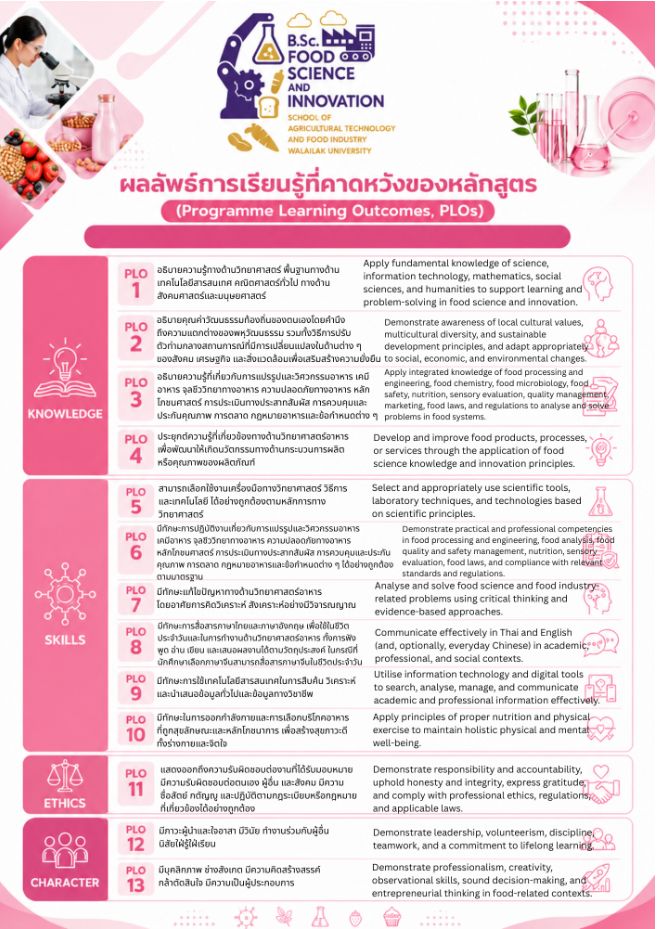
Program Learning Outcomes (PLOs)
To produce graduates with competencies in the following four areas:
-
Knowledge
PLO1: Explain the knowledge in science, mathematics, statistics, chemistry, physics, biology, and their applications (FSMLO1 + FSMLO2 + FSMLO3).
PLO2: Describe the value of one’s own local culture while considering multicultural differences, and methods for adapting to changes in various aspects of socioeconomic and environmental contexts to enhance sustainability (GELO1 + GELO2).
PLO3: Explain knowledge related to food science, food chemistry, food microbiology, food processing, and food quality control (SPEC).
PLO4: Describe the knowledge of applying diverse resources and wisdom to food science (SPEC + GELO3). -
Skills
PLO5: Demonstrate the skill in selecting and using scientific tools, methods, and technologies correctly according to scientific principles (FSMLO4).
PLO6: Exhibit professional skills in food science, food chemistry, food microbiology, food processing, and food quality control to work in the food industry, food business, or related fields (SPEC).
PLO7: Demonstrate problem-solving skills in food science in a rational and systematic manner by utilizing analytical and synthetic knowledge (GELO4 + FSMLO6).
PLO8: Have effective communication skills in Thai and English or Chinese (depending on the student’s choice) for presentation and work purposes (GELO6).
PLO9: Demonstrate skills in using information technology or software appropriately for searching, screening, collecting, analyzing, and presenting data in professional tasks (GELO5 + GELO7 + GELO8).
PLO10: Have skills in physical exercise or maintaining proper hygiene in food consumption to promote good physical and mental health (GELO9).
PLO11: Demonstrate skills in teamwork and effective leadership (GELO11). -
Ethics
PLO12: Show responsibility towards assigned tasks, personal and social responsibility, integrity, and adherence to relevant rules and laws (FSMLO5 + GELO10). -
Character
PLO13: Exhibit leadership and volunteer spirit, work collaboratively with others, adapt, self-develop, and solve problems amidst diversity (University-specific).
PLO14: Demonstrate the ability to be an innovator in food science, using knowledge in food science, management, and innovation to seek career opportunities (SPEC + GELO3).
Total Credits Required for the Program:
135 credits in a semester-based system
Curriculum Structure
1.General Education Courses: At least 26 credits
Students must choose either 9 credits of English or 9 credits of Chinese.
2.Specific Courses: At least 99 credits
3.Elective Courses: At least 8 credits
Career Opportunities Available After Graduation
1.Production Supervisor
2.Quality Assurance and Quality Control Supervisor
3.Research and Development Scientist
4.Food Safety and Food Standards Officer
5.Food Product Specialist
6.Healthy Food Developer
7.Scholar, Scientist and Researcher
8.Technical Sale Representative
9.Business owernes
10.Consultant
Admission Requirements
1.Must have completed upper secondary education or an equivalent program that includes studying science subjects such as Chemistry, Biology, Physics, and Mathematics from an institution recognized by the Ministry of Education.
2.Must have completed an associate degree, a bachelor’s degree, or an equivalent qualification from an institution recognized by the university council.
3.Must meet additional criteria deemed appropriate by the academic council for admission.
4.Must not have any serious communicable diseases or conditions that could hinder their studies, in accordance with Walailak University regulations on undergraduate education in the semester-based system, B.E. 2566.